Certificates: make learning achievements visible and verifiable
Create personalized certificates, define assessment criteria and give achievements a verification link.
Reaching a learning milestone deserves a clear acknowledgement. For a learner, it can be a record of effort and progress. For an organization, it is a chance to explain what an achievement represents and how it was awarded.
Certificates in eDoer connect that acknowledgement to the learning path. Organizations can design a certificate template, personalize its details and choose how eligible learners receive it.
Start with what the certificate means
Before designing a certificate, decide which milestone it recognizes. A clearly named learning path and an explicit assessment requirement help learners understand what they are working towards.
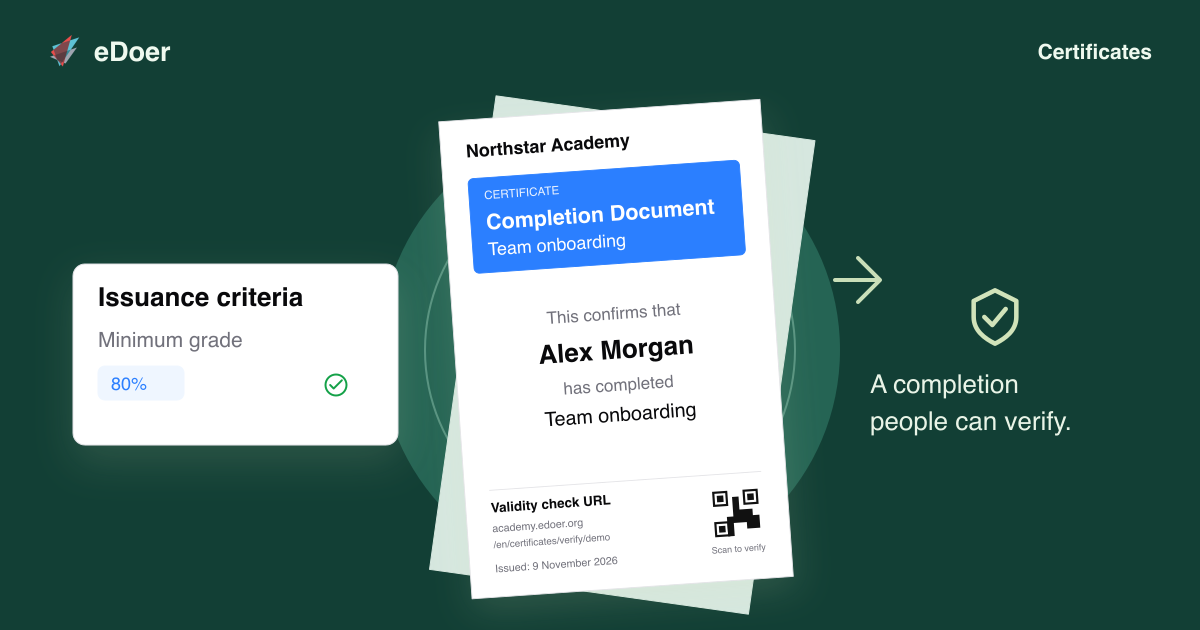
eDoer supports assessment-based issuance criteria, including a minimum grade. Automatic issuance can follow a qualifying assessment result, while manual issuance gives curators a way to award a certificate directly. The organization determines the meaning and criteria of its award.
Create a consistent, personal record
A learning-path template provides the basis for issued certificates. Supported placeholders bring in details such as the learner’s name, issue date, learning-path title and organization name, together with verification information.
This gives an organization a consistent document while making each issued certificate specific to its recipient. The certificate can then be printed using the dedicated print presentation.
- Use a template associated with the learning path.
- Include the recipient and relevant achievement details.
- Provide verification information with the certificate.
Give the record a way to be checked
Each issued certificate has a unique public verification code. A verification link and QR code provide a route back to the platform, so the recipient can share a checkable record of the certificate.
Issued certificates also preserve a snapshot of their template. Editing the template for a future group therefore does not rewrite the document that an earlier learner received. That distinction helps keep the record connected to its original issuance.
Make recognition part of the journey
A certificate works best when learners know about it early. Explain the criteria in the learning path, make the assessment relevant to the intended outcome and tell learners where to find their certificate once it is issued.
The document is one part of a wider experience: a clear goal, meaningful learning activities and an acknowledgement at the end. eDoer brings those pieces together so organizations can recognize progress with a consistent process.
The takeaway
Pair clear achievement criteria with a personalized certificate that recipients can print and others can verify.